
I’ve always been a bit of an electronics geek. Not hardcore, mind you, but I’ve always enjoyed tinkering and figuring out how things work.
As a kid, much to my parents’ and grandparents’ chagrin, I took a lot of toys apart. Eventually, that curiosity extended to perfectly good transistor radios, alarm clocks, and just about anything else that happened to be left lying around the house.
Some of that was probably my dad’s fault.
He worked in commercial radio and had a natural aptitude for the technical side of things. Through osmosis, I developed an interest in electronics at a fairly young age.
I’ll never forget the goofy little earpiece that came with the first crystal AM radio I built. It was a Radio Shack kit that didn’t even need a battery – it drew the tiny amount of power it needed from the radio signals themselves.
I thought that was just about the coolest thing imaginable.
When Dad realized how fascinated I was by this silly little radio, he bought me a much larger Radio Shack electronics project kit.
Looking back, the thing was pretty ridiculous-looking, but it was brilliant from an educational perspective. Each component was connected to a little spring, and you used jumper wires to connect the springs together and complete different circuits.
You could build all sorts of things without needing to solder a single connection.
In Grade 4, I won the school science fair by connecting two hobby motors together and demonstrating electrical generation. Ironically, I powered the first motor with a battery, but the project gave me an opportunity to explore magnetic fields and mechanical-to-electrical energy conversion.
It also earned me what was probably the best mark of my elementary school career.
Enter VE3NRQ
My first real exposure to amateur radio came through my Scout leader, Bill White, VE3NRQ.
He used to joke that NRQ stood for Never Really Quiet.
Anyone who knew him would probably agree that it was a particularly appropriate callsign.
He regularly brought handheld radios to Scout meetings and would show us the mobile radio installed in his GMC Jimmy during camping trips.
This was long before smartphones and ubiquitous internet access. The idea that you could pick up a radio and communicate with someone miles away, without relying on the telephone network, was fascinating.
He made radio seem both mysterious and completely accessible.
At camp, he’d demonstrate communications between people who were relatively close together. You could physically see both ends of the conversation, which helped make sense of what was happening.
Then came Jamboree on the Air (JOTA).
JOTA opened up an entirely different world. Suddenly, radio wasn’t just about talking to someone on the other side of the campsite. It was about communicating with people much farther away, potentially around the world.
By then, I probably thought I knew everything there was to know about radio.
I most certainly did not.
But that’s one of the wonderful things about amateur radio – the more you learn, the more you realize how much there is left to discover.
The Licence That Didn’t Happen
I remember wanting to get my amateur radio licence back then, but the process seemed intimidating.
I don’t recall all the specifics, but I remember hearing about studying for an examination and possibly having to build a radio.
For a kid without a job, the financial aspect was concerning.
The prospect of studying was even worse.
So, despite the interest, I never quite took the next step.
The fascination with electronics, however, never went away.
By high school, I’d become reasonably proficient at soldering, which made my Grade 10 technology teacher, Mr. Laan, particularly frustrating.
He insisted on pronouncing solder exactly as it was spelled.
Eventually, he admitted that he knew it was commonly pronounced “sawder” and had been deliberately saying it differently as a teaching lesson.
Fine. I guess you’re alright, Mr. Laan.
In that same class, we had the opportunity to purchase and assemble small electronic kits from a catalogue.
While most of the other students worked on one project, I was building them at roughly a two-to-one ratio.
Apparently, the fascination hadn’t worn off.
Coming Full Circle
It took considerably longer than I’d imagined, but eventually I did find my way into amateur radio.
Today, I’m VE3FOO, operating from London, Ontario.
My station has an Icom IC-7300, VHF/UHF radios, SDR receivers, antennas, computers, and an ever-growing collection of projects that I never seem to have quite enough time to finish.
Some days I’m trying to make a distant HF contact. Other days I’m experimenting with satellite reception, digital modes, or figuring out why something that worked perfectly yesterday has suddenly stopped cooperating.
In many ways, I’m still that kid connecting wires between springs on a Radio Shack project board.
The equipment has changed, but the curiosity hasn’t.
And I can trace a meaningful part of that curiosity back to a Scout leader who took the time to bring his radios to meetings and camping trips and show a bunch of kids what was possible.
I doubt he realized at the time how much of an impression those experiences would leave.
A Small World – Another Familiar Callsign
Years later, after becoming involved in amateur radio myself, I discovered another familiar face from my Scouting days.
My former Cub leader, Al McRorie, VE3GAM, was a member of the London Amateur Radio Club (LARC).
It was a neat connection to make after all those years. Someone I’d known as a Cub leader was also part of the amateur radio community I’d eventually joined.
Unfortunately, I don’t have any photographs of myself with Bill White from those early radio demonstrations or JOTA events. I do, however, have an old Cub Scout photograph.
It seems fitting to include it here. While it doesn’t capture the radio experiences themselves, it’s a little snapshot of the Scouting years that helped set me on this path.
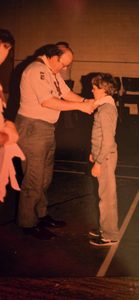
Funny how these connections come back around.
And as an aside, I’ve heard through Jr. Jr. that Jr./Sr./VE3NRQ is alive and well – quiet, perhaps, but certainly not silent.
Which seems fitting for someone whose callsign was, after all, Never Really Quiet.
73 de VE3FOO

